(LITTLE ROCK, Ark.) — An independent review of Arkansas’ Family Centered Treatment initiative finds the intensive in-home program is helping keep children safely with their families, strengthening communities, and saving state dollars.
Family Centered Treatment (FCT) is an evidence based, trauma informed model that provides intensive in home therapy for families dealing with serious behavioral health and relationship challenges. In Arkansas, the program operates through a partnership between the Arkansas Department of Human Services (DHS) and the Family Centered Treatment Foundation after being launched in 2024 as part of the Roadmap to a Healthier Arkansas initiative.
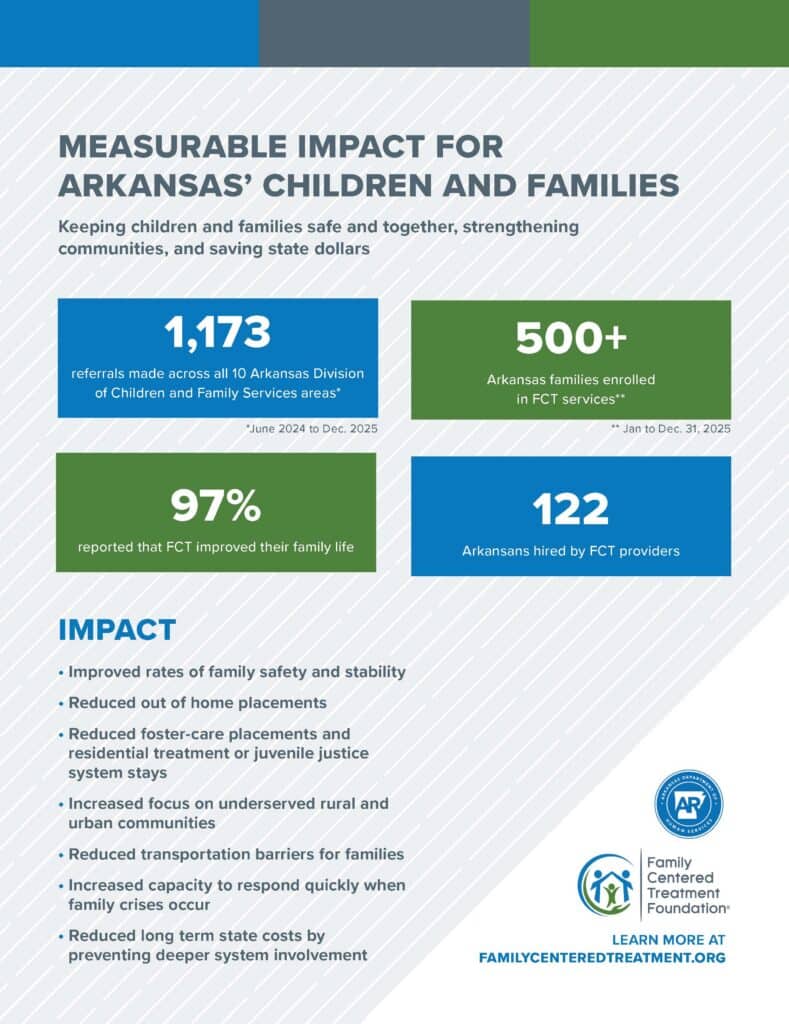
Independent evaluators found that FCT achieved high rates of family stability and significantly reduced out of home placements for participating children. From Jan. 1 to Dec. 31, 2025 alone, more than 500 Arkansas families enrolled in FCT services. Among families who completed these services, 97% reported that FCT improved their family life, and only 6% required a higher level of care at discharge.
[INFOGRAPHICS for broadcast or print use: Full page | Half page]
The evaluation also showed improvements in children’s behavior, caregiver functioning, and overall family safety, which help prevent foster care placements and stays in residential treatment or juvenile justice system facilities.
“In Arkansas, we have already seen the difference that intensive, preventive services can make,” said Tim Wood, CEO of the Family Centered Treatment Foundation, which trains and supports local providers across the state. “Our work shows that when families receive the right tools and support in their own homes, they can move from crisis toward resilience and reconnection.”
The findings mirror national results showing that FCT keeps families together during treatment at high rates, reduces the need for out of home care and lowers long term costs by preventing deeper system involvement.
“Rather than separating children from their families, Family Centered Treatment offers a better way,” Wood said. “We focus on healing within the home, where trust can be rebuilt and long term well being can take root.”
The initiatives outlined and implemented from the Roadmap to a Healthier Arkansas report all focus on prevention, treatment, and stabilization/recovery. The FCT pilot launched under the prevention initiatives to deliver a family-centered treatment approach rather than focusing on the child alone. The program goal was to serve at least 600 families through the FCT program, and to date 954 families have been served.
Since 2024, FCT Arkansas has grown from a targeted capacity-building pilot to a statewide network of agency providers serving families across every region of the state, ensuring families in both urban and rural areas have access to the same intensive in-home support.
The evaluation notes that the FCT Foundation contracted with Sells Agency, a Little Rock based marketing and public relations firm, on a public awareness campaign to spotlight local providers’ services, as well as its staff and success stories as FCT expanded in Arkansas.
From June 2024 to December 2025, FCT providers hired 122 staff members, and 1,173 referrals were made across 70 counties by Provider led Arkansas Shared Savings Entities and other sources, including child welfare and juvenile justice agencies.
“Arkansas has shown a strong commitment to helping children grow up safely in their own homes whenever possible,” said Paula Stone, Director of the Office of Substance Abuse and Mental Health within DHS. “The evaluation confirms that FCT is an effective way to stabilize families in crisis, reduce unnecessary foster care placements, and give children the opportunity to heal within the strength of their own homes.”
FCT is part of Arkansas’ broader effort to implement services for children and their families who are involved in one or more systems within DHS.
“By integrating with child welfare, behavioral health and juvenile justice partners, the program provides courts, schools, and community agencies with a proven in-home option to help families stay together,” Stone said.
The evaluation highlights the role of the DHS–FCT Foundation partnership in building a high quality, accountable system. DHS provides oversight, funding and alignment with statewide child welfare and behavioral health goals, while the foundation provides training, coaching, fidelity monitoring and technical assistance to Arkansas providers.
The initiative places a special focus on underserved communities that previously had limited behavioral health resources and minimal family support infrastructure. By partnering with local providers and sending teams directly to families’ homes, FCT reduces transportation barriers and other challenges that often keep families in remote areas from getting timely help. State supported in home services allow clinicians and paraprofessionals to meet families where they are and respond quickly when crises occur.
“Too many families in rural communities have not had access to needed services and supports,” Stone said. “FCT changes that equation by bringing intensive, evidence based treatment into the home, whether that home is in Little Rock or in the Delta.”
The evaluation found that by reducing reliance on high cost residential treatment and other institutional placements, FCT helps lower system costs over time. Continuous quality improvement reviews and data tracking keep program performance, family outcomes and spending closely linked, allowing DHS to make data driven decisions about future investments.
“Arkansas has demonstrated what can happen when public agencies and nonprofit partners work side by side around a shared mission of keeping families together,” Wood said. “By investing in in home therapy, trauma informed training and rigorous quality improvement, the state is not only improving outcomes for children but also being a good steward of taxpayer dollars.”
DHS and the FCT Foundation plan to use the evaluation findings to refine training, support and outreach, with a continued focus on rural access, family voice and long term sustainability.
Families, providers or referral sources interested in learning more about Family Centered Treatment in Arkansas or locating a local FCT provider can visit www.fctar.org or contact DHS through the PASSE ombudsman’s office at 844-843-7351 or by email at [email protected].
Media interested in speaking with FCT leadership can reach out to Rob O’Connor at [email protected].
About Family Centered Treatment Foundation, Inc.
The Family Centered Treatment Foundation, Inc. is a national organization dedicated to supporting and expanding the Family Centered Treatment (FCT) model, an evidence-based, trauma-informed approach that keeps families together through intensive, home-based therapeutic support. With decades of proven success, the Foundation provides training, research, and guidance to behavioral health providers across the country. Its mission is to empower communities with effective tools to heal families, reduce out-of-home placements, and foster long-term stability.